

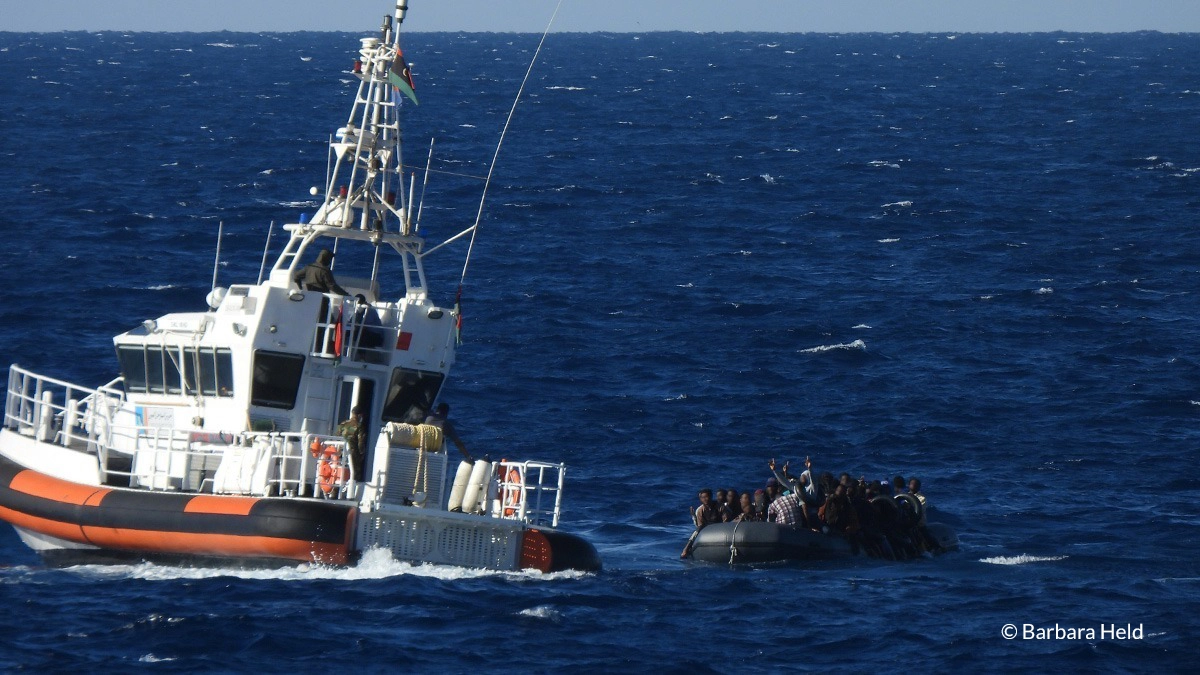
Court emphasizes: Decisions by captains during sea rescues must be respected – authorities must prove violations.
After rescuing 65 people in summer 2025, Italian authorities detained the rescue ship SEA-EYE 5 for 20 days in the port of Pozzallo. The crew members and captain were accused of disregarding instructions from the Maritime Rescue Coordination Centre Rome, failing to request the disembarkation port “in a timely and official manner,” and delaying the onward journey to the assigned port of Taranto. Sea-Eye e.V. challenged these accusations in court – successfully: The competent civil court has now declared the detention unlawful and ordered the Italian authorities to cover the legal costs.
In June 2025, SEA-EYE 5 rescued 65 people from acute distress at sea in the Mediterranean. Many of those rescued were in poor health; several individuals required urgent medical care and had to be evacuated. The Italian Maritime Rescue Coordination Centre Rome instructed the crew to conduct a vulnerability assessment and divide those rescued between two ports: some were to disembark at nearby Pozzallo, while others were to go to the much more distant Taranto. Given the medical situation and the responsibility for all those rescued, the crew decided against separating the group – whereupon SEA-EYE 5 was detained.
Anna di Bari, board member of Sea-Eye, states: “In times of massive political attacks on civilian sea rescue, this ruling is an important victory. It confirms: Our work not only respects the law, it defends it and saves lives. While we are repeatedly accused of breaking the law, this ruling shows once again that it is the political attacks on sea rescue that undermine law and humanity. We will continue to stand firmly for the rights of people fleeing, not only at sea but also in court.”
The court ruling clarified two central points. First, the court confirmed – contrary to Sea-Eye’s legal position – that Italian authorities can also impose sanctions for actions that occur on the high seas. Second, the ruling strengthens the decision-making authority of captains in rescue situations: Their professional assessment during an operation must be fundamentally respected. Sanctions are only permissible if decisions are arbitrarily aimed at disregarding official instructions – and the authorities must prove this arbitrariness in each individual case.

