

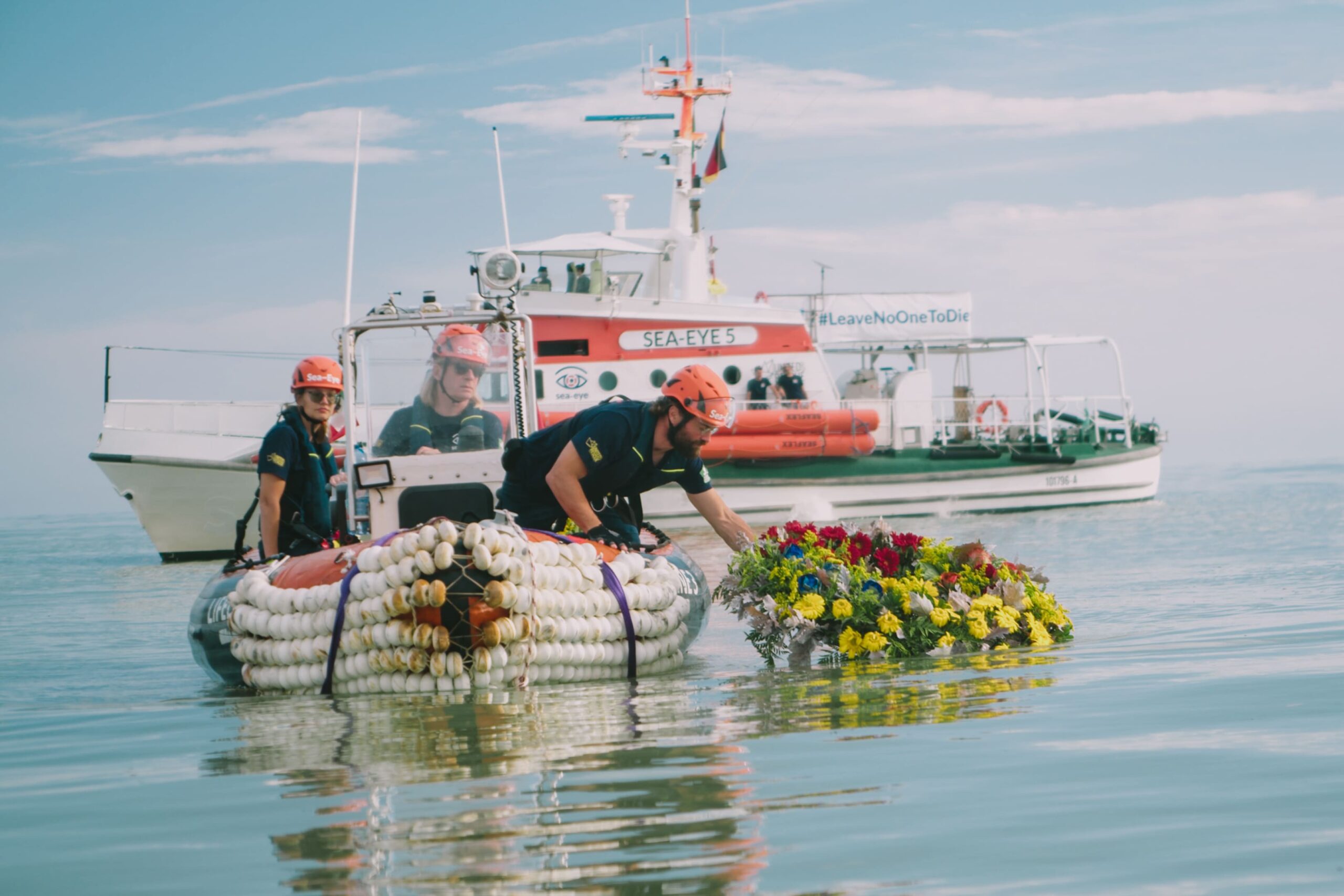
75 years of the Geneva Convention on Refugees and more than 1,300 people have already died or gone missing in the Mediterranean this year alone
On World Refugee Day, Sea-Eye turns its attention to the plight of refugees in the Mediterranean and to one of the most important human rights documents of our time: the Geneva Convention on Refugees. This international treaty, which celebrates its 75th anniversary this year, continues to form the basis for the protection of people fleeing war, persecution and violence.
”The Geneva Convention on Refugees reminds us that protection is not a privilege, but a right.
Anna di BariVorstandsmitglied von Sea-Eye
The need for this protection is evident every day in the Mediterranean. According to the International Organisation for Migration (IOM), in the first half of 2026 alone, more than 1,300 people died or went missing whilst fleeing across the Mediterranean – and the actual figure is thought to be significantly higher. Behind these figures are people who have lost their lives in their search for safety. This is a harrowing reality that must not be forgotten, particularly on World Refugee Day.
As a civilian maritime rescue organisation, Sea-Eye has for years witnessed how saving lives is becoming increasingly difficult. Political and bureaucratic measures are putting pressure on civilian rescue organisations and hindering life-saving operations. At the same time, for many survivors, the uncertainty does not end with their arrival in Europe. The reform of the Common European Asylum System (CEAS) threatens to impose further restrictions on access to protection and fair asylum procedures.
Against this backdrop, the anniversary of the Geneva Convention on Refugees takes on particular significance. The Convention was drawn up in 1951 in response to the experiences of the Second World War. In the wake of the crimes of Nazism and the failure of many states to protect people fleeing persecution, the aim was to ensure that those seeking protection were guaranteed fundamental rights – regardless of their origin, religion or political beliefs.
Yet 75 years on, these principles are coming under increasing pressure. When policymakers call the Geneva Convention on Refugees into question, it is not only international protection standards that are severely undermined; the historical lessons learnt from war, persecution and displacement are also in danger of being forgotten.
“Human rights apply to everyone – including, and especially, people fleeing their homes,” explains Anna di Bari, CEO of Sea-Eye, on World Refugee Day. “The Geneva Convention on Refugees reminds us that protection is not a privilege, but a right. As sea rescuers, we see first-hand every day what is at stake when this right is disregarded. Our mission is to save people from drowning and to look where others look away. We stand for solidarity and human rights – at sea and on land.”
The urgency of this debate is also highlighted by the documentary film “No Land for Nobody”, which is being screened in numerous cinemas across Germany to mark World Refugee Day. Sea-Eye released this documentary last year in collaboration with a coalition of organisations comprising Pro Asyl, the Mennonite Relief Organisation, Sea-Watch, German Doctors and United4Rescue. The film highlights the consequences of European migration policy and draws attention to the realities of life for people fleeing their homes, as well as the challenges faced by civilian sea rescue organisations.
To mark World Refugee Day and the 75th anniversary of the Geneva Convention on Refugees, Sea-Eye calls for the protection of people fleeing their homes not to be viewed as a political bargaining chip, but as an expression of humanity, solidarity and responsibility under the rule of law. Developments in the Mediterranean and at Europe’s external borders show that the values enshrined in the Geneva Convention on Refugees 75 years ago are more relevant today than ever.

